
Problem gambling rarely announces itself. The shift from entertainment to compulsion happens gradually — a slightly larger bet after a loss, a session that runs an hour longer than planned, a third deposit in a week when two used to be the maximum. By the time most players recognise the pattern, weeks or months of escalating behaviour have already passed.
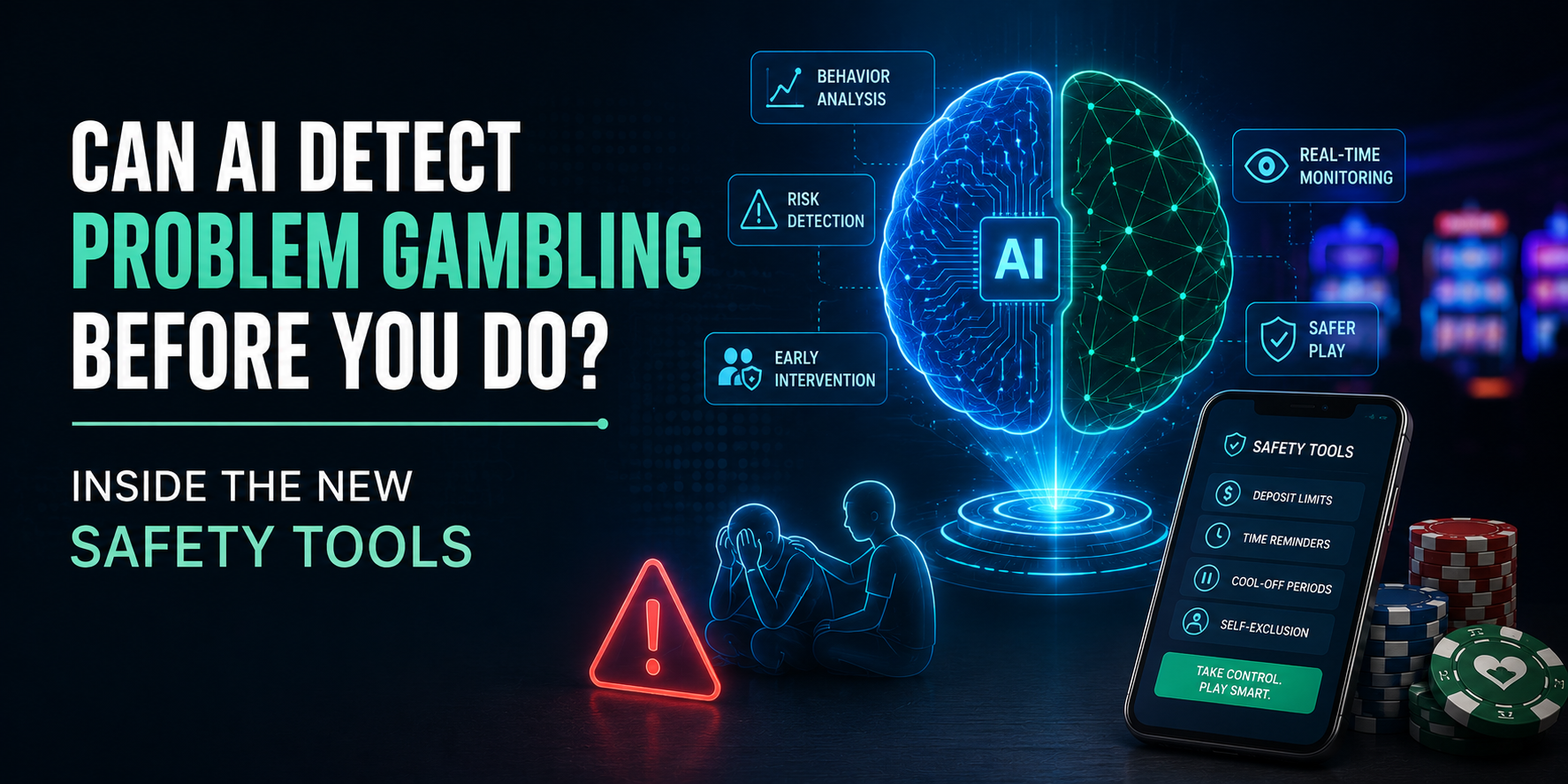
This is precisely the gap that artificial intelligence is now designed to close. A growing number of online casino operators have deployed machine learning systems that monitor player behaviour in real time, identify early warning signs of problem gambling, and trigger interventions before the player reaches a crisis point. These tools are not theoretical — they are live, operational, and increasingly mandated by gambling regulators worldwide.
Here is how they work, what they actually detect, and what this means for players at trusted casino Singapore platforms.
How AI Monitors Gambling Behaviour
AI-driven problem gambling detection systems analyse dozens of behavioural data points from every player session. Unlike traditional responsible gambling tools that rely on players to self-assess and self-limit, these systems run continuously in the background, processing patterns that humans would find impossible to track at scale.
The core behavioural markers fall into four categories:
1. Session Length Tracking
The system records how long each player stays active on the platform during every session. It establishes a baseline for each individual — perhaps a player typically logs 30–45 minute sessions on weekday evenings. When that same player suddenly begins playing for 3–4 hours at a stretch, or starts logging in at 2am when they have never played after midnight before, the system flags the deviation.
Research published in the Journal of Gambling Studies has consistently identified extended session duration, particularly sessions that break from a player's established routine, as one of the strongest early predictors of developing gambling problems. The AI does not just measure session length in absolute terms — it measures it relative to each player's own historical norm.
2. Deposit Pattern Analysis
Deposit behaviour is one of the richest data sources for detecting risk. The AI tracks:
- Deposit frequency: How often a player tops up their balance and whether the frequency is increasing
- Deposit amounts: Whether individual deposit sizes are growing over time
- Rapid redeposits: Deposits made within minutes of a previous balance reaching zero — a strong indicator of chasing behaviour
- Failed deposit attempts: Multiple failed deposits in quick succession can indicate a player urgently trying to add funds beyond their financial means
- Total spend trajectory: The overall spending curve over days, weeks, and months
A player who deposited SGD 50 twice a week for three months and then suddenly deposits SGD 200 three times in a single day has generated a clear risk signal, even if they have not exceeded any preset deposit limit.
3. Bet Size Escalation Detection
Bet size escalation — progressively increasing wager amounts over time — is a well-documented behavioural marker of gambling problems. The AI monitors average bet size per session and tracks the trend line. A gradual but consistent upward trajectory in average bet size, especially when combined with increasing session frequency, triggers a heightened risk score.
The system also detects sudden bet spikes: a player who normally bets SGD 2 per spin suddenly placing SGD 50 bets is exhibiting a pattern that, statistically, correlates with loss-chasing or emotional gambling.
4. Chasing Behaviour Recognition
Loss-chasing — increasing bets or playing longer immediately after losses in an attempt to recover — is considered the single most reliable predictor of problem gambling in the academic literature. AI systems are specifically trained to detect this pattern.
The detection works by correlating bet size changes with win/loss outcomes. If a player consistently increases their bet after a losing streak and decreases it after a win, the system identifies a chasing pattern. Similarly, if a player's session length extends significantly on losing days compared to winning days, the model interprets this as an inability to walk away from losses.
Real AI Systems Used by Operators
Several commercial AI platforms are now deployed across hundreds of licensed online casino operators globally. The three most prominent are:
Mindway AI (GameScanner)
Developed by Danish neuroscientists, Mindway AI's GameScanner is one of the most widely adopted player protection systems. It uses a classification model trained on clinical gambling disorder data to assess real-time player behaviour. The system assigns each active player a risk score on a continuous scale and updates it in real time as new data flows in.
GameScanner monitors over 14 distinct behavioural markers and cross-references them against patterns observed in clinically diagnosed problem gamblers. When a player's risk score exceeds a defined threshold, the system alerts the operator's responsible gambling team for review and potential intervention.
Mindway AI has published peer-reviewed research demonstrating that GameScanner can identify at-risk players with over 80% accuracy — significantly better than traditional self-reporting methods, which rely on players recognising and admitting to their own harmful patterns.
BetBuddy (Playtech)
BetBuddy was developed by Playtech, one of the world's largest gambling technology companies. It uses unsupervised machine learning to build individual behavioural profiles for every player, then detects deviations from those profiles that indicate increasing risk.
BetBuddy's approach is notable because it does not require pre-labelled training data (i.e., it does not need to know which players eventually developed problems). Instead, it identifies anomalous behaviour within each player's own history. This makes it effective at catching unusual patterns even in player populations that have not been clinically studied.
The system is integrated directly into Playtech's casino platform, which means any operator using Playtech software can activate BetBuddy without additional integration work.
Neccton (mentor)
Neccton's mentor system takes a slightly different approach by combining AI-driven detection with automated player communication. When the system identifies concerning behaviour, it can automatically generate personalised messages to the player — not generic pop-ups, but communications that reference the player's specific behaviour patterns.
For example, a player flagged for rapidly increasing session length might receive a message noting that their average session time has increased by 150% over the past two weeks, along with a prompt to set a session time limit. This specificity makes the intervention feel more relevant and less like a generic compliance checkbox.
Neccton's system is deployed across multiple European markets and has been adopted by several operators that serve Asian markets, including platforms accessible from Singapore.
How Players Receive Interventions
When an AI system flags a player as at-risk, the response follows a tiered escalation model. The specific actions vary by operator, but the general framework is consistent across the industry:
Tier 1: Gentle Nudges
- On-screen pop-up reminders showing total time played or total amount wagered in the current session
- Prompts suggesting the player take a break or set a deposit limit
- Links to responsible gambling resources and self-assessment tools
- Display of net win/loss figures for the session to provide reality checks
Tier 2: Automated Restrictions
- Temporary deposit limits applied to the account automatically
- Cooling-off periods that prevent play for 24–72 hours
- Session length caps that log the player out after a defined period
- Bonus and promotional offers temporarily suspended to reduce gambling incentives
Tier 3: Human Review and Intervention
- The player's account is escalated to a trained responsible gambling officer
- The officer reviews the full behavioural history and AI risk assessment
- Direct contact may be made with the player (email, phone, or in-app message)
- Account restrictions or mandatory self-exclusion may be imposed
The inclusion of human review at the highest tier is important. While AI excels at detecting statistical patterns across millions of data points, the decision to restrict a player's account involves nuance that algorithms handle poorly. A responsible gambling officer can distinguish between a one-off unusual session and a genuine escalating problem in ways that pure automation cannot.
Singapore's NCPG and Self-Exclusion
Singapore has its own established framework for addressing problem gambling through the National Council on Problem Gambling (NCPG), which operates under the Ministry of Social and Family Development.
The NCPG administers several key programmes:
- Casino Exclusion Orders: Individuals can apply for voluntary self-exclusion from both Marina Bay Sands and Resorts World Sentosa. Family members can also apply for exclusion orders on behalf of a problem gambler through a family exclusion process.
- Casino Visit Limits: Players can set a limit on the number of casino visits per month through a formal application.
- Helpline and Counselling: The NCPG operates a 24-hour helpline (1800-6-668-668) and provides free counselling services for problem gamblers and their families.
- Public Education: The NCPG runs awareness campaigns and provides self-assessment tools to help individuals evaluate their own gambling behaviour.
For responsible gambling Singapore, the NCPG framework remains the most comprehensive local resource. However, its enforcement mechanisms are primarily designed for land-based casinos and Singapore Pools. International online casino operators fall outside the NCPG's direct jurisdiction, which is where operator-level AI tools become particularly important as a complementary safety layer.
AI vs Self-Assessment: How They Compare for Early Detection
Traditional responsible gambling approaches rely heavily on player self-assessment. Tools like the Problem Gambling Severity Index (PGSI) ask players to answer questions about their own behaviour — how often they bet more than they can afford, whether they feel guilty about gambling, whether others have expressed concern.
Self-assessment has a fundamental limitation: it requires honest self-reflection during a period when the person's judgment about their own behaviour may already be impaired. Research consistently shows that problem gamblers underreport the severity of their behaviour, not out of deliberate dishonesty, but because denial and normalisation are intrinsic features of the condition.
AI detection offers several structural advantages over self-assessment:
| Factor | Self-Assessment | AI Detection |
|---|---|---|
| Objectivity | Subjective — relies on honest self-evaluation | Objective — based on measurable behavioural data |
| Timing | Periodic — only when the player chooses to self-assess | Continuous — monitors every session in real time |
| Early Detection | Often late — problems are recognised after they are entrenched | Often early — statistical patterns emerge before conscious awareness |
| Scale | Individual — one player at a time | Population-wide — monitors all active players simultaneously |
| Denial Resistance | Vulnerable — denial undermines accuracy | Resistant — behavioural data does not lie |
| Nuance | High — player can provide context about their situation | Limited — patterns without context can generate false positives |
Neither approach is sufficient on its own. The most effective responsible gambling framework combines AI-driven monitoring (for early, objective detection) with self-assessment tools and human review (for context and nuance). Players who want to stay safe should use both — engage with the self-assessment tools their casino offers while also choosing operators that deploy genuine AI monitoring systems.
What This Means for Choosing a Casino
Not every online casino invests in AI-driven player protection. The presence of these tools is a meaningful indicator of an operator's commitment to responsible gambling — and by extension, their overall trustworthiness.
When evaluating a casino, look for:
- Explicit mention of AI-driven or algorithmic player protection in their responsible gambling policy
- Customisable deposit, loss, and session time limits in the account settings
- Easy-to-find self-exclusion options that can be activated without needing to contact support
- Links to external support resources, including the NCPG for Singapore players
- Proactive session reminders and net position displays during gameplay
Operators that deploy tools like Mindway AI, BetBuddy, or Neccton are investing real money in player protection infrastructure. That investment correlates strongly with legitimate licensing, fair game practices, and reliable payout behaviour — the same qualities you should be looking for when choosing a safe casino.
The Bottom Line
AI can detect problem gambling patterns earlier and more objectively than most players can detect them in themselves. The technology is real, it is deployed at scale across licensed operators, and it represents a genuine advancement in player protection.
But it is not a substitute for personal awareness. If you notice your sessions getting longer, your deposits getting larger, or your mood deteriorating after gambling, do not wait for an algorithm to tell you something is wrong. Singapore's NCPG helpline (1800-6-668-668) is free, confidential, and available 24 hours a day. Taking that call will always be a more reliable first step than any AI-generated pop-up.