
Plinko is the "drop a ball and watch it bounce" game that has spread from crypto casinos into the Fast Games and crash-game lobbies of many Asian-facing sites. It takes ten seconds to learn, which is exactly why it is worth understanding properly. Behind the bouncing ball is a simple piece of probability that decides how often you hit the big edge multipliers, and that is almost never.
This guide explains how Plinko works, the real odds of each slot, what the risk and row settings actually change, the published RTP of the versions you are most likely to see, and how to set a sensible budget for it.
How Plinko Works
- Choose your stake Set the amount per ball, for example SGD 1.
- Pick rows and risk Most versions let you choose the number of peg rows (often 8 to 16) and a risk level such as Low, Medium or High. Some use coloured balls instead of a risk menu.
- Drop the ball The ball falls through a triangle of pegs, bouncing left or right at each row.
- Get paid by the slot It lands in one of the slots along the bottom, each showing a multiplier. A 0.5x slot returns half your stake; a 29x slot returns 29 times it.
The bouncing is animation. The result comes from a random number generator (RNG) or, on crypto sites, a "provably fair" seed system. The physics on screen simply shows you a path that matches that result.
The Maths: Why the Middle Always Wins the Crowd
On a standard Plinko board, each row is effectively a coin flip: left or right, 50/50. With n rows there are 2n equally likely paths, and the number of paths that end in a given slot is a binomial coefficient, C(n, k). So the chance of landing in slot k is C(n, k) ÷ 2n.
That gives a bell shape. The centre slots can be reached by many different paths; the outer slots by exactly one. On an 8-row board, there are 256 paths and only one of them ends in the far-left slot.
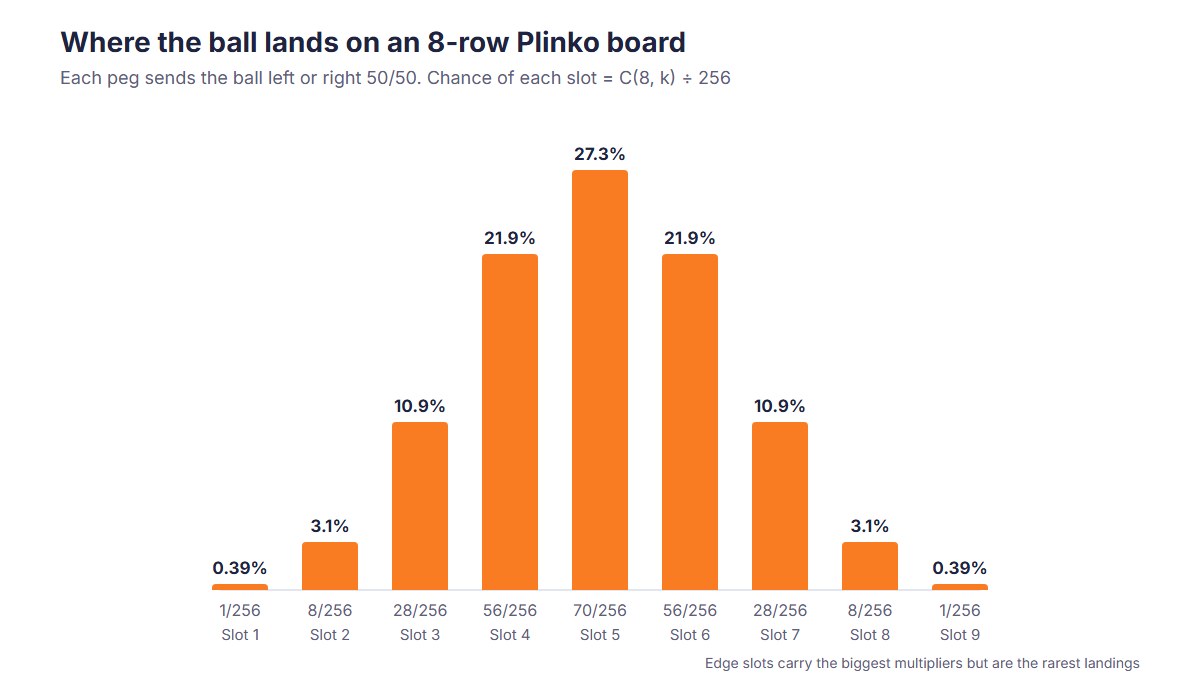
8 rows: odds and a typical paytable
The table below combines the exact probabilities with a widely used 8-row paytable (the one found on Stake's in-house Plinko and many similar games). Your game's numbers may differ, but the structure will be the same.
| Slot | Paths | Probability | Low | Medium | High |
|---|---|---|---|---|---|
| 1 | 1/256 | 0.39% | 5.6x | 13x | 29x |
| 2 | 8/256 | 3.13% | 2.1x | 3x | 4x |
| 3 | 28/256 | 10.94% | 1.1x | 1.3x | 1.5x |
| 4 | 56/256 | 21.88% | 1x | 0.7x | 0.3x |
| 5 | 70/256 | 27.34% | 0.5x | 0.4x | 0.2x |
| 6 | 56/256 | 21.88% | 1x | 0.7x | 0.3x |
| 7 | 28/256 | 10.94% | 1.1x | 1.3x | 1.5x |
| 8 | 8/256 | 3.13% | 2.1x | 3x | 4x |
| 9 | 1/256 | 0.39% | 5.6x | 13x | 29x |
Multiply each multiplier by its probability and add them up, and every risk column comes out at roughly 99% (98.9% to 99.1%, with the small differences caused by rounding the multipliers). That is the RTP: on average, 99 cents back per SGD 1 dropped.
12 rows: the edges get very thin
More rows means more paths (4,096 for 12 rows) and a more extreme spread. Probabilities are symmetrical, so slot 1 and slot 13 share the same odds.
| Slot | Paths | Probability (each) |
|---|---|---|
| 1 and 13 | 1/4,096 | 0.024% |
| 2 and 12 | 12/4,096 | 0.293% |
| 3 and 11 | 66/4,096 | 1.61% |
| 4 and 10 | 220/4,096 | 5.37% |
| 5 and 9 | 495/4,096 | 12.08% |
| 6 and 8 | 792/4,096 | 19.34% |
| 7 (centre) | 924/4,096 | 22.56% |
On a 12-row board an edge slot is hit about once in every 4,096 drops. If that slot pays 170x on High risk, you might drop thousands of balls without seeing it, and that is normal behaviour, not a broken game.
Risk Level Changes Variance, Not RTP
The most common Plinko misunderstanding is that High risk is "better" or "worse" value. In well-known versions it is neither. The risk setting moves money between slots: High risk pushes more value to the rare edge slots and pays less than 1x in the middle, while Low risk keeps most slots near 1x.
Using the 8-row paytable above, the standard deviation of a single drop (how far one result typically sits from the average) is about 0.56x on Low, 1.24x on Medium and 2.67x on High. Same average return, very different ride:
- Low risk: on 8 rows only the centre slot (about 27% of drops) returns less than your stake, and then you still get half back. Most other drops return 1x to 1.1x, so your balance drifts slowly.
- High risk: the three centre slots (about 71% of drops) pay 0.3x or less. You lose most of each stake most of the time, waiting for a 4x, 29x or rarer result.
Rows work the same way. More rows spread the outcomes wider and usually raise the top multiplier, while the RTP is kept roughly constant. Always check the paytable in your specific game, because a few versions do vary RTP by setting.
RTP of Popular Plinko Versions
| Game | Published RTP | Settings |
|---|---|---|
| Spribe Plinko | 97% | 12, 14 or 16 rows; green, yellow and red balls as risk levels; top multiplier 555x (red, 16 rows) |
| BGaming Plinko | 99% | 8 to 16 lines; Low, Normal and High risk |
| Stake Plinko (Stake Originals) | 99% | 8 to 16 rows; Low, Medium and High risk; up to 1,000x on 16 rows High |
RTP figures are as published by the providers and review databases at the time of writing and may vary by casino, since some operators can choose a different configuration. Open the game's rules or info panel to see the figure your casino is running. A 97% game costs you three times as much per drop, on average, as a 99% one.
RNG vs "Provably Fair" Plinko
Plinko games come in two technical flavours. Studio games such as Spribe's and BGaming's use a certified RNG, tested by an independent lab, the same way a slot is. Crypto-casino originals often use a provably fair system instead: before each drop the casino commits to a hidden server seed (shown to you as a hash), you supply or accept a client seed, and the result is calculated from both plus a counter. After you change seeds, the casino reveals the old server seed so you can recompute every result yourself.
Provably fair proves that a result was not changed after you bet. It does not change the house edge. A 99% RTP game is still a 1% edge game, however transparent the seed system is.
Plinko Compared With Other Fast Games
| Game type | Typical RTP range | What you control |
|---|---|---|
| Plinko | 97%–99% | Stake, rows, risk level |
| Crash games (e.g. Aviator) | about 97% | Stake and when to cash out |
| Slots | often 94%–97% | Stake and game choice |
In crash games, cashing out earlier or later changes variance, much like Plinko's risk level, but not the long-run return. The same logic applies across this whole category: pick the version with the highest published RTP and decide your limits before the first drop.
Where You Will Find Plinko in Singapore-Facing Casinos
Plinko usually sits outside the main slots lobby. Look for tabs named Fast Games, Crash, Instant Games or Mini Games, alongside titles like Aviator. BK8, for example, groups this kind of quick-fire game under its Fast Games lobby. Which Plinko versions are live depends on the operator's provider deals, so the selection can change.
Two practical points before you play:
- Bonus terms: many welcome offers exclude or limit instant games, and some count them at a reduced rate toward turnover. Read our guide to turnover requirements before opting in.
- Auto-drop speed: autoplay can drop several balls a second. At SGD 1 per ball and a 1% house edge, 1,000 drops is SGD 1,000 wagered and about SGD 10 expected cost; on a 97% game it is about SGD 30. Speed turns a small edge into a real number.
Bankroll Tips for Plinko
- Decide the session budget first Pick an amount you are fine losing, for example SGD 100, and do not top it up mid-session.
- Match risk to budget On High risk, the expected run between big hits is long. If your budget only covers 100 drops, Low or Medium risk is the more realistic choice.
- Keep stakes at 1% or less SGD 1 per ball on a SGD 100 budget gives you room for the normal swings.
- Limit autoplay Set a fixed number of drops and a loss limit inside the autoplay menu, rather than leaving it running.
- Ignore patterns Each drop is independent. A run of centre landings does not make the edge slots "due".
If you enjoy the low-skill, quick-result feel of Plinko, it is worth comparing with slots, where RTP and volatility work the same way; our guides to slot RTP and volatility explain those ideas in more depth.
Legal and Responsible Play Note
Singapore's Gambling Control Act 2022 regulates all forms of gambling, including online, and only a small number of operators such as Singapore Pools are licensed locally. Many Plinko games are offered by offshore and crypto casinos that are not licensed in Singapore. Read our guide on safe and legal betting in Singapore to understand the position before you deposit anywhere.
Plinko's speed makes it easy to lose track of time and money. Use deposit limits, take breaks, and visit our responsible gambling page for tools and local support if you need them.
Frequently Asked Questions
-
Yes. Your choices are stake, rows and risk level. Once the ball is dropped, the slot is decided by an RNG or provably fair seed, and the on-screen bounces just illustrate that result.
-
It depends on the version. Spribe Plinko publishes 97%, while BGaming Plinko and Stake's in-house Plinko publish 99%. Operators can sometimes run different configurations, so check the info panel in your casino.
-
Not on average. In the common versions, Low, Medium and High risk have about the same RTP. High risk moves value to the rare edge slots, so results swing more and most drops return less than your stake.
-
On an 8-row board each edge slot is hit 1 time in 256 (0.39%). On 12 rows it is 1 in 4,096, and on 16 rows it is 1 in 65,536.
-
No strategy changes the odds. What you can control is the version you choose (higher RTP is cheaper), your stake size, the number of drops and when you stop.